Accurate water metering is not just about buying a good meter or installing it neatly in a water meter box. If the installation is not done according to the manufacturer’s specifications, even high-quality meters will not be accurate.
For South African municipalities, body corporates, industrial sites and plumbing contractors, incorrect meter installation can result in:
- Lost revenue and an increase in non-revenue water (Water Loss)
- Incorrect consumption measurement resulting in billing disputes and unhappy customers
- Shortened meter working life resulting in additional unnecessary replacements
This article explains seven common installation traps that quietly destroy accuracy and how to avoid them on your sites.
Why incorrect meter installation has such a big impact on accuracy
Meters are calibrated and verified under controlled conditions. Once installed in the field, the meters are exposed to real-world issues such as pressure fluctuations, air in the line, poor pipe layout and incorrect placement of shut off valves etc.
If water meters are not installed in accordance with the manufacturer’s specifications, a calibrated/verified meter that should be accurate to within 2% can drift far out of specification. The problem often only surfaces when:
- Meter readings and consumption data look incorrect.
- Accounts spike or drop with no obvious reason after a meter replacement.
- A non-revenue water investigation begins because of a perceived water loss. (Meter under registering)
Getting the installation right from day one is often the cheapest “fix” you will ever make.
1. Air pockets and entrained air
The problem
Air in the pipeline is one of the biggest enemies of meter accuracy if air relief valves are not installed at all high points. In applications where air is hard to eliminate (intermittent supply, rooftop tanks, booster pumps), ultrasonic smart meters that handle challenging conditions can be worth considering alongside good air management.
This problem is especially common in South African systems, where you see:
- Intermittent supply
- Rooftop tanks
- Booster pumps
- Pipe repairs and new connections
How it affects accuracy
- Air can cause the meter to over-register.
- Mechanical meter types will suffer increased wear and/or irreparable damage when high velocity air passes through the measuring chamber.
What to do
- Install meters only in sections of pipe that remain fully flooded.
- Install the meter strictly according to the manufacturer’s installation instructions.
- Install air-release valves at high points upstream of the meter to remove air in the line.
- When a pipeline is commissioned or repaired, open the valve slowly until all air is flushed from the line.
- Avoid installing meters immediately after pumps or fittings that are likely to introduce vibrations and air unless the manufacturer specifically permits it
2. High-point meter installations
The problem
Meters sometimes need to be installed at a high point in the line. This is an ideal place for air to collect and stay trapped.
Examples include:
- Pipe runs that rise over an obstacle and then fall again.
- Above-ground stands where the meter body sits higher than the rest of the line.
- High points on mountain sides, hills etc.
How it affects accuracy
- The pipe may never run completely full, especially at low flow rates.
- Air pockets and air passing through the meter will cause over-registration resulting in inaccurate meter readings and management data.
- In extreme cases where an air pocket forms in the meter, the meter will not function at all.
What to do
- Avoid high-point locations for meters wherever possible.
- Keep meters in straight, level sections of pipe that remain full under normal operating conditions. Meters are designed to measure full bore flow.
- Where it is unavoidable to install a meter at a high point, install suitable air-release valves and ensure that system pressure remains high enough to keep the line full
- Follow the manufacturer’s recommended installation drawings.
3. Partially open or obstructed shut off valves
The problem
A valve that is not fully open or that is being used for throttling will cause problems if it is too close to a meter. This can be a common issue on older sites where a stopcock, gate valve or butterfly valve is left “half open” to control flow.
How it affects accuracy
- A partially open valve creates a high velocity jet effect through the meters and causes turbulence and uneven flow profile passing through the meter. This will result in the meter accuracy going out and over the meter will register.
- Flow turbulence and high velocity caused by the restriction will also shorten the life of the meter and can cause irreparable damage.
What to do
- Use valves next to meters for isolation only, not for flow control
- Make sure isolation valves are always fully open in normal service
- If the system needs controlled pressure or flow rate, install a proper control valve in the correct position with the manufactures specified straight pipe lengths fitted upstream and downstream of the meter.
- During site audits and commissioning, physically check the operation of shut off valves. Do not rely only on handle position only.
4. Not enough straight pipe upstream and downstream
The problem
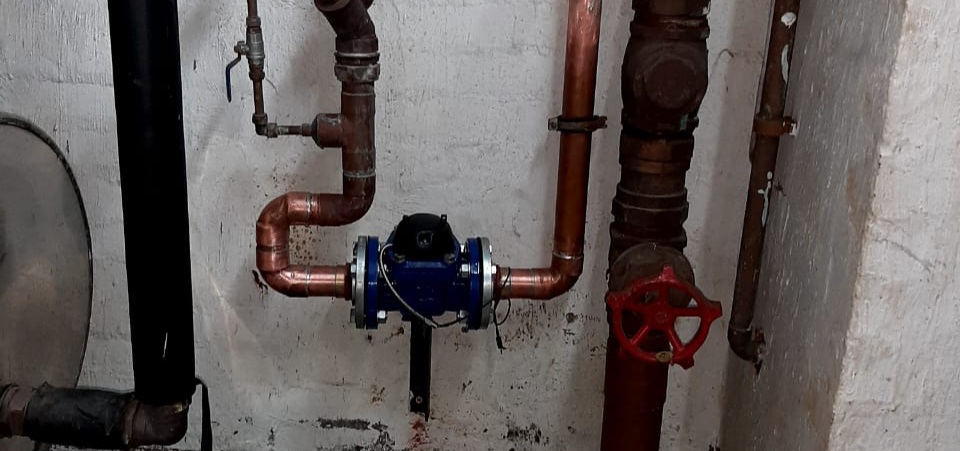
Meters are often squeezed into small boxes, chambers or crowded plant rooms without consideration for the meter manufacturer’s installation requirements and instructions. This leads to elbows, tees, valves and other fittings being installed directly in front and/or after the meter. This will cause the accuracy of the meter to be affected.
In the meter installation instructions supplied with the meter, most manufacturers require a minimum length of straight pipe free of fittings, bends and tee’s fitted upstream and downstream of the meter. For example, a certain number of pipe/meter diameters long fitted upstream and downstream of the meter.
How it affects accuracy
- Fittings close to the meter disturb the flow profile and can create swirl. This can have either a positive or a negative effect on the meter’s accuracy.
- The meter is designed to work with a fully developed laminar flow profile with the highest velocity passing through the centre of the meter. Disturbed flow and turbulence introduces measurement error across the whole flow range
- The error can be consistent and repeatable, which means it quietly distorts every meter reading resulting in inaccurate consumer consumption data.
What to do
- Check the installation manual for minimum straight lengths and respect them
- As a general rule of thumb (always confirm for your meter type), aim to fit several pipe diameters of straight pipe upstream and downstream of the meter
- Avoid installing any meter directly after 90-degree bends, tees, partially open valves, pumps or pressure-reducing valves
- Where space is very limited, speak to the manufacturer about approved flow conditioners or alternative layouts
- This is especially important on bulk installations, where the manual is specific about straight lengths and layout — see Woltmann bulk meter installation requirements and Class B Woltmann meter specs and install guidance.
5. Incorrect meter orientation and position
The problem
The meter is installed in a position that does not match the manufacturer’s instructions.
Examples include:
- A meter that is designed and approved for horizontal installation only is installed vertically
- Meters installed on their side or even upside down
How this affects accuracy
- Mechanical meters rely on gravity, backpressure and correct flow direction to perform as designed
- Incorrect orientation can cause wear and drag on the meter’s impeller, and it places stress on moving parts. This drag causes the meter to under measure.
What to do
- Always follow the arrow which is cast or printed on the meter body. This indicates direction of flow.
- Always install the meter in a horizontal of pipe run with the register facing upward, unless the manual clearly approves other options
- Avoid positions where air can sit in the meter body
- For electronic meters, make sure all sensing elements are under water and cabling is routed as recommended
6. Flow Rates at the metering point fall outside the meter’s rated measuring range
The problem
The flow rates at the metering point fall outside of the installed meters measuring range. This happens when:
- The meter size is chosen to match the pipe diameter at the metering point without consideration for the flow rate profile at the metering point (this is common on smaller supplies too, so it’s important to right-size domestic meters for low and peak flows).
- Peak flows regularly exceed the meter’s overload flow rate rating
- Meters are oversized “for safety”, so the normal operating flow can be far below the meter’s measuring range
This is common on mixed-use applications where domestic demand, irrigation and industrial processes share lines.
How it affects accuracy
- At very low flows rates which are below the meter’s rated minimum flow rate specifications will lead to under measurement, water loss and lost revenue
- Operating for long periods near the meter’s upper limit can damage the meter and shorten its working life
- The result is that the meter spends most of its time either under-registering or being stressed
What to do
- Size meters based on the meters measuring performance specifications, typical and not on pipe size alone
- Use manufacturer datasheets to match expected flows to the correct meter size and technology
- On sites with very different demand patterns, consider separate meters or different sizes for different legs, for example domestic supply and irrigation
- Review consumption data regularly to see whether a meter spends most of its time in a very low or very high part of its range.
NB. Never install a meter which is larger than the pipe size. When downsizing a meter, never install a meter more than one size smaller than the pipe size.
7. Poor water quality and debris management
The problem
Many water networks in South Africa, especially older ones or areas with intermittent supply, carry suspended solids like sediment, rust, scale and other debris. If the meter has no protective strainer or the line is not flushed properly prior to installation, this material ends up inside the measuring chamber.
How it affects accuracy
- Suspended solids like grit and sand will cause wear and damage the meters internal components and change the meters measuring performance over time
- Sediment build-up narrows the flow passage which alters the velocity profile and affects meter accuracy
- In extreme cases the meter or downstream plumbing can become partially blocked which negatively affects meter accuracy severely
What to do
- Install strainers where recommended by the manufacturer. This is particularly advisable on older pipes or in dirty systems
- Position strainers so that these can be accessed and cleaned
- After major pipe repairs or new connections, flush the line thoroughly before bringing the meter online
- For consistently dirty water, consider meter technologies that are more tolerant of sediment eg. Electronic ultrasonic meters.
The hidden trap: weak commissioning and no baseline data
The problem
Even a neatly installed meter can give trouble if the commissioning process is rushed.
Why it matters
- Without basic checks and baseline readings, it is difficult to tell whether the meter is behaving correctly from the start
- Small errors often go unnoticed until they have affected many months of billing
Good commissioning practice
- Confirm pressure, flow conditions and valve positions when the meter is first opened to service
- Check for visible leaks and air release
- Record an initial reading and, on critical installations, compare it against a known test volume or a reference meter
- Keep a simple commissioning record with photos, readings and notes, which makes later troubleshooting much easier
Why this matters
For South African users, these installation traps have real financial consequences:
- Municipalities face higher non-revenue water and revenue loss
- Estates and body corporates deal with disputes over shared consumption and “unfair” accounts
- Industrial and commercial users struggle to track process water accurately and manage costs
Many of these issues are blamed on “faulty meters”, but a large proportion can be traced back to the how the meter was installed and commissioned.
When to involve a specialist
It is worth involving a specialist meter supplier or installer when:
- You are planning bulk or district metering projects
- There are pumps, pressure-reducing valves or complex hydraulics near the proposed meter location
- You are installing larger diameter meters
- You see unexplained changes in consumption after meter replacements
A specialist can:
- Help select the correct meter type and size
- Advise on layout, straight lengths of pipe and valve positions
- Support commissioning and troubleshooting on site
Key points to remember
To ensure meter accuracy and reduce headaches later:
- Install meters in sections of pipe where there is full bore, and manage air with correct venting
- Install the recommended straight lengths of pipe upstream and downstream of the meter
- Do not throttle flow with isolation valves right in front of the meter
- Follow the manufacturer’s installation instructions with regard to orientation and flow direction
- Size meters using real flow rate data, and not pipe size alone
- Manage suspended solids and sediment with strainers and proper flushing
- Commission meter properly and keep basic records
Need help with water meter installations in South Africa?
If you are dealing with unexplained consumption, frequent meter changes or ongoing billing disputes, it may be worth reviewing the installation before blaming the meter itself.
You are welcome to contact our team for:
- Site assessments and installation advice
- Help with meter selection and sizing
- Support with commissioning and audits of existing meters
We work with South African municipalities, property managers and businesses to keep meters accurate and reliable over their full service life.
Read a case study to learn how Precision Meters assisted a residential estate in fixing water losses due to ageing infrastructure and leaks throughout the complex.